vasárnap, január 21, 2007

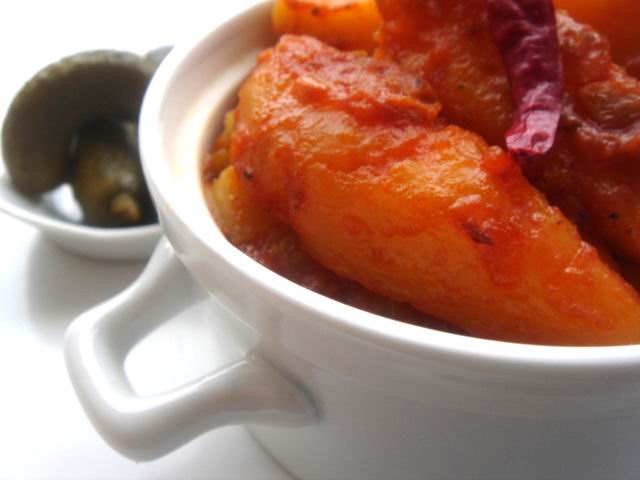
Waiter, there is something in my..STEW. Hungarian meatless potato goulash
Oops, I almost missed the new monthly event called Waiter, there is something in my.. , which will be hosted through one year in rotation by Andrew, Johanna and Jeanne. Great idea! The first edition has been announced and hosted by Andrew at Spittoonextra and this time the theme of the event is STEWS. Of course I feel obliged -it would be such a great shame if I didn’t participate in this one –hey, I’m Hungarian and one of the most famous stews ever supposed to be our goulash I guess (or let’s formulate it this way: whatever dishes called in the world goulash).

My obvious choice would be to post about a real, authentic Hungarian goulash- I did that already earlier so I don’t want to repeat myself. You can read about some terminology, the method we Hungarians prepare our goulash and about the recipe here in this older post.

Hungarian cuisine obviously absorbed a lot of influences from the countries of the Austro-Hungarian Monarchy (and vice versa) I always love to read about all the various takes towards a dish, (e.g. goulash) and really enjoy it to stumble upon familiar taste combinations on different blogs. I particularly enjoy Johanna’s or Angelika’s dishes (both Austrian). Look at their goulaschsuppe, fiakergulasch or mushroom goulash.

This time I prepared a meatless potato stew (which btw I hope qualifies for the event) which I really love but don’t cook that often. To tell you the truth, this (no meat) is not very typical Hungarian –at home we would almost always add some smoked sausages or frankfurters. Johanna also has a great recipe –mine is similar but slightly different. Let me introduce you to the Hungarian version, our Paprikás krumpli or potato goulash.

This is so simple –in fact a typical peasant dish which you will often find in the rural areas and family cooking but rarely in restaurants. It’s a favorite everyday dish in Hungary –it’s cheap , filling and a big crowd pleaser. My non-Hungarian friends absolutely love it and ask me to cook it very often. As this is such a simple dish with a few ingredients only, the final outcome very much depends on the quality of the ingredients you use: good quality potatoes are essential (some sort that don’t fall apart)–I like to use the red-skinned ones- and of course some really good paprika –if you have access to Hungarian sweet paprika –that’s the thing . For the absolutely authentic flavor I would use white peppers which I can’t get here (or only sometimes at the Turkish grocery) and a a very tasty (and almost healthy) pork fat from a special Hungarian pig called mangalica (which is highly demanded nowdays, very fashionable and extremely tasty. Due to its high quality and features most of it goes to Spain where it’s transformed into jamón Serrano..)

Recipe (4 servings)

1 kg (2lbs) potatoes (use type that don’t fall apart),peeled and cut into long quaters
2-3 big onions, finely chopped
4tbsp lard (or oil)

3 tbsp best quality Hungarian sweet paprika
salt, pepper
2 cloves garlic
1 green pepper, sliced (preferably the white one, if not available, use the thinner skin Turkish green peppers but not bell peppers)
1 fresh small tomato (this one I add only f I can get some really tasty good quality, otherwise I skip it)

Heat lard/oil in a saucepan. Add the finely chopped onions and cook until translucent. Remove the saucepan from the heat and now add the paprika – this is very important as if you would do this step still on the heat, the paprika could burn from the sudden heat and get bitter. Put it back, add the potato chunks and stir so that the onion-paprika mix covers the vegetables evenly. Brown for a few minutes, then cover with water so that the liquid almost covers the potatoes. Add the sliced green pepper, the garlic cloves, the whole tomato (this one will be removed at the end of cooking), salt, pepper. Simmer covered on very low heat until the potatoes are cooked (the cooking time depends on the type of potato you use, about 20-25 minutes). Check sometimes and add a litle more water if necessary, so the stew doesn’t burn. It depends on your taste how you like the stew: if you like more sauce, just add more water during cooking. If you prefer a thick sauce (like I do) and the sauce is too watery at the end, just cook the stew for a few minutes uncovered until the sauce reduces. Serve with pickles (and some great bread). And a good Hungarian red wine.


Címkék:


péntek, december 08, 2006

Hungarian mushroom soup with sour cream

Magyarul hamarosan
You know, we Hungarians are totally crazy and passionate about or soup.
I cook soup at least 2-3 times a week but ask either a Hungarian mother feeding a family and children or someone who lives in the countryside and they might tell you easily that they prepare a soup every single day of the week. We are definetely a soup nation and that’s why I was so happy to discover a foodblog event focusing on soups. Tami, a pretty Atlanta based food and fashion stylist (who, according to her introducion btw is „the perfect mix of carrie bradshaw and nigella lawson - at least in her head”) and writer of the great blog Running with the Tweezers announced this event called The Souper Challenge Blog Event asking us to share a favorite soup recipe

Soups are an integral and extremely important part of Hungarian cuisine, a meal will almost always start with a soup and be normally followed by a main dish (and eventually dessert). When eating out in restaurants, even for dinner(!) a lot of people will order a soup as an appetizer. A restaurant menu in Hungary will always include a very wide choice of different soups, much more really then in other countries.
I live in Brussels, Belgium at the moment and whenever I have Hungarian friends flying over and visiting, the second day at the very latest I’m going to whip up a soup for them beause I know how badly they miss it.

The majority of Hungarian soups are thickened in some way, the almost only traditional „clear soup” being „húsleves”, (meat soup). This is a classic meat broth cooked mostly from chicken or beef and eaten at Sunday lunch family gatherings but also at festive occasions. At weddings, even in the city, this is often the highlight of the menu. In my family the cooked vegetables and meat are being served separately with horseradish or a light sauce (like the French pot au feu or the Austrian Tafelspitz) and after that the clear broth is eaten with vermicelli or some other noodles.

Veloutés and puréed soups are also popular but the really typical, more rustic soups are red in color, contain pieces of vegetables, maybe some meat, Hungarian paprika and are thickened with a browned roux (prepared with oil or lard) or sour cream. Nowdays, there are a lot of efforts to make our rather heavy dishes a little lighter and so often cornstarch is being used as a thickening agent in soups.

I cooked this mushroom soup a few days ago and thought that it’s a nice traditional recipe which is maybe appreciated also by people abroad. You don’t need any special ingredients except of the good quality bright red Hungarian paprika.

Recipe (2 servings)

1/2lb (ca. 250g) mushrooms, sliced
½ onion, finely chopped
1 heaped tsp Hungarian sweet paprika
2cups (500ml) chicken stock
4tbs sour cream
2tbs flour
4tbsp chopped flat leaf parsley
salt, freshly ground black pepper
3tbsp oil
(optional: a piece of a fresh white pepper and half a tomato)

In a saucepan, heat the oil. Add the finely chopped onion and cook on low heat until translucent. Take the pan off from the heat and add the paprika. (This is an important step as on high heat the paprika would quickly acquire a bitter taste) Put back and keep stirring. Add the sliced mushrooms, keep on stirring and browning. Now add the stock. Season with salt and pepper, cook for a few minutes. (If you manage to get some fresh white peppers and a good tomato, add now and remove when the soup is ready) In a separate bowl or mug, mix the flour with sour cream until smooth. Add a few tbsp of the cooking liquid and mix to get a lumpfree mixture. Pour this slowly back into the soup. Bring to boiling point and cook for a few minutes. Finally, add fresh chopped parsley at the end.

Some other posts in English

Címkék:


vasárnap, október 01, 2006

Five (Hungarian) things to eat before you die

MAGYARUL
Now, I’m so late with this one. Melissa at the wonderful The Travelers Lunchbox started this huge joint project called „Things to eat before you die” already a month ago. She asked all foodbloggers to name five things that they’ve eaten and think that everyone should eat at least once before they die. Many people were complaining that the most challenging thing was to actually restrict our contributions to FIVE items, that’s really so hard. In the meantime that list has grown to an amazing 1505 food items contributed by almost 300 foodbloggers from all over the world – it contains different items from as simple as a good bread or a good olive oil to more exotic stuff like prahok, the Cambodian fermented fish paste or oysters. Go and check-out that list. I’ve been also tagged by Johanna for this one and as the list could serve also as a kind of global food guide, I’m of course adding items from my own cuisine:HUNGARIAN to it. Here it goes:


1. Hungarian cakes and pastries – Eszterházy cake
This is what we are most famous for. To be honest, I could immediately easily name five of these (and much more) but that would be just too simple. All of our sweets are absolutely fantastic but it’s not always easy to find the very best of it, there is a lot of mediocre food like everywhere. The most known cake is probably Dobos torta, a layered chocolate cake with a crunchy caramel topping, however I personally prefer another one: Eszterházy torta, which is a walnut sponge cake filled with a walnut creme and topped with a sweet icing. By the way the best cakes in Budapest are sold at the patisserie called DAUBNER (it’s located totally outside of the touristy area, it's a bit time consuming to get there, but really worth the effort. They are doing very well without a website). The second choice would be a strudel with sourcherry filling. Or cottage cheese. Or maybe poppyseed. (For this one I go early in the morning when they are freshly made to a place called SZALAY cukrászda near the Parliament) And I could of course go on with palacsinta (crepes), túrógombóc (cottage cheese dumplings), mákos guba (poppyseed bread&butter pudding), but I’m already cheating.

2. Hungarian goose foie gras –prepared Hungarian style

Did you know that Hungary is the world's second-greatest foie gras producer (after France of course) and the largest exporter of it? Large part (more then the half in fact) of the French goose liver import comes from Hungary –French companies then spice, process, and cook the foie gras and sell it as a French product. You will find foie gras on Hungarian restaurant menus prepared in the common way –as a paté, pan-seared or roasted, served with brioche, fruits and sweet wines. But if you have the chance, please try it once the other way: In Hungary, we like to fry the goose foie gras (which we can get fresh at the market) in goose fat, which is seasoned with some paprika and garlic, then poured over the foie gras and left to cool. We eat it with fresh white bread, sliced red onions and tomatoes.
PS. Production is not banned in Hungary (and it’s not likely to happen because it’s a tradition and thousands of farmers depend on it), so come to Budapest to have some!

3. A proper Hungarian goulash
I mean the real stuff. Hot and spicy, made with real, good quality Hungarian paprika, white peppers, good tomatoes and pork fat. Preferably cooked at someones home.

4. Pickled cucumbers (kovászos uborka)
In the summer, almost every single family will prepare its own homemade pickled cucumbers (or buy it at the market). Boiling salted water is poured over them, they are seasoned with garlic and dill and a few slices of white bread will help the fermentation process. It’s a seasonal delicacy as hot weather is needed. To be eaten ice cold, crunchy, delicious!

5. Homemade chicken soup cooked with parsley root
I just love chicken soup, if it’s a good one I could eat it every single day. Finding parsley root is difficult in most countries, but if you happen to discover some, buy it. It looks like parnsnips but it’s thinner. A stock prepared with it tastes a lot more different. It gives this special, unique, earthy aroma, which I always miss abroad, so I better always travel with a bunch of it from Hungary.

As I live in Belgium, Brussels at the moment, if I could name a sixth item, right now it would be fresh mussels cooked in white wine with tons of garlic and parsley. I just can’t get enough of them when they are in season.
I'm not tagging anyone but I would be really curious to read the opinion of other Hungarian foodbloggers.


Címkék: ,


csütörtök, augusztus 31, 2006

Food Destinations #2 –My local greenmarket: BUDAPEST, Hungary


It’s been a while I’ve posted in English (I do in Hungarian), I know and I need to admit, the one and only reason for that is my own laziness I’m afraid. Anyway, I was really angry with myself when I missed the first round of this event a couple of months back but was so happy to discover that there is a second round featuring our local greenmarkets this time. Inventor and host of the Food Destinatios event, Maki (who is a Japanese American ex-Tokyoite, ex-New Yorker, currently living in Switzerland) at I was just really hungry, wrote in her announcement:” Ask yourself the question: If my favorite foodie/food blogger came to my town, where would I take him/her?”

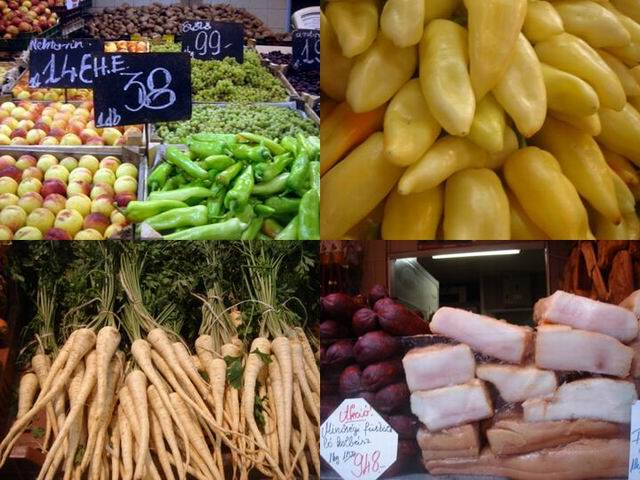
Now how great is this: I didn’t really need to use my imagination as that is exactly what happened. Danielle writes her lovely foodblog Habeas Brulee from New York, Brooklyn and she came to Hungary with her family to see the small village in the Eastern part of Hungary where her grandmother was born. A couple of weeks ago, Danielle still in New York, me still in Brussels (where I live at the moment), a few e-mails back and forth, and we have easily arranged to meet in Budapest. So this Tuesday, I took her, her boyfriend and her cute little brother, Jordan to the Central Market Hall „Nagycsarnok” which is the biggest and most famous one in Budapest. We have had a great time I think and I myself enjoyed it very much to see the market from a little different perspective, through the critical eyes of a foreigner. As her grandma and also her mother cook Hungarian food at home, Danielle is familiar with Hungarian cooking, the typical dishes, main ingredients and spices to be used, but still, I tried to show her a few things that are maybe not so obvious as paprika and salami.

There are many nice markets in Budapest, the Central Market Hall being definitely the most beautiful and impressive. It’s not really a farmers greenmarket in classical terms, because that’s not so common in the city (rather in the countryside), although in the back of the hall you will also find a few farmers selling their own homegrown produce. At the market, you will find all kinds of products, mainly food but also souvenirs, their quality ranging from bad to superb.

The beautiful building itself was built in 1897 and has been completely restored in 1994. You can read extensively about the history here. Obviously it’s also very touristy although that doesn’t mean at all that locals wouldn’t do their shopping here. They do. I do. However, you need to be aware of and prepared for huge tourist crowds, all of them trying to buy their paprika. The market is a little bit more quiet in the first half of the week and during the day. Try to avoid Saturday morning, that’s when most of the people do their food shopping for the weekend and it’s so very crowded. It’s closed on Sundays.

We buy our fruits and vegetables here –you will be familiar with most of them, nothing exotic on that side–but there are some special Hungarian varieties, which you won’t find anywhere else. You will see huge mountains of sweet white peppers which we eat as they are, in salads and sandwiches and use also for cooking – for our famous goulash or for lecsó, the Hungarian ratatouille, a very typical summer dish. In general, fruits and vegetables are extremely tasty because of the good climate and a lot of sun. Try some white peaches or plums during summer, pears and grapes int he fall. During summertime you will see bags of shredded summer squash –we use it for one of our typical summer dishes, tökfőzelék, a vegetable dish seasoned with fresh dill and thickened with sour cream. You will also see bunches of parsnip like roots – that’s parsley root which is not available in most parts of the world. We cook it in chicken soup and stocks, it gives a fantastic earthy flavor. Try it and don't tell the secret to anyone..

Now over to the meat section (hope this is allowed in a post about greenmarkets…) There are dozens of butcher stalls, selling fresh meat or poultry and hundreds of different cured, smoked, yummy sausages, salami, ham and some interesting stuff which might sound bizarre for some nations. You will for example see piles of cracklings, the crunchy fried fat skin of either pork or goose. We eat it with fresh bread and red onions. Or you will find (in case you recognize it) pieces of smoked beef tongue behind the counter, pig feet, tripe, and co. As for the sausages, there are many brands, it’s not at all easy to find the best quality. I really recommend asking some locals for tips; you will always find friendly people who will be happy to advise you. The butcher stalls also sell blocks of foie gras –the goose liver is of fantastic quality (did you know that a great part of French foie gras comes from Hungary?) and is much cheaper then in other countries, it’s very worth to purchase some.
Downstairs you will smell the difference – fish+ pickles. Try the pickles – homemade pickled cucumbers, sauerkraut, pickled stuffed peppers, very typical, very good.

All in all, a quick summary- try and buy: spicy sausage (kolbász), pickles, foie gras, paprika spice, Hungarian honey, Hungarian white peppers, curd cheese made of sheep milk (juhtúró), bunches of dried chili and garlic.
Don’t: saffron (it’s not the real thing), exotic fruits, wine (preferably in a special wine store).

Come to Budapest for more!

Danielle, how did you like the cserkészkolbász:)?

Central Market Hall
1093 Budapest, Vámház körút 1-3.
Opening hours:Mon: 6.00 am - 5.00 pm
Tue-Fri: 6.00 am - 6.00 pm
Sat: 6.00 am - 2.00 pm
Sun: closed
map


Címkék:


péntek, március 31, 2006

And he again rings twice..EBBP#4 this time from France

This has been my second time participating in the EuroBlogging by Post event and certainly not the last one..Last time I received a wonderful parcel from Johanna. After returning back from New York I just couldn’t wait to see Andrew’s e-mail saying to which country in Europe and to which other foodblogger I’m going to send my foodie parcel. Andrew was the host of this round – a big big Thank you goes to him for this ( I have the feeling that it must take a lot of energy and nerves to organize an event like this with all that personal e-mailing and tracking..just look at his roundup)
When my parcel finally arrived I just absolutely couldn’t wait to see from whom it comes…it came from the charming Fanny at FoodBeam, a wonderful blog which I already knew and which I visit and like a lot! Fanny is French, she lives in Toulouse in France and makes absolutely wonderful food photography. She has a lot of great sweet recipes on her site but also some other creative cratfy things.
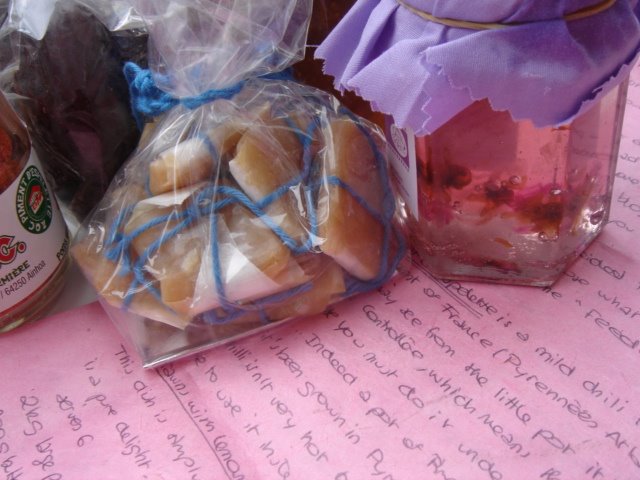
This is what I received from Fanny:

- A jar of Piment d’Espelette – a mild chili from Espelette, a small town in the Pyrennées Atlantiques region of France where it is grown under special conditions (apelation d’origine controllée). Fanny suggest to use it instead of piri-piri for example in this prawn recipe from the famous Tessa Kiros cookbook

- Confit de Violette – a violet jam -do you see on my picture how beautiful this is? Toulouse is the city of violets and this beauty comes from the best shop int he town selling violet products (I’ve been to Toulouse and I actually remember this shop!). Fanny recommends to try it as a syrup over vanilla ice cream (hmm..) or as a a glaze for duck. To be tested!

- A bag of fantastic quality medjol dates – this is already gone..khm..

- A bag of Fanny’s homemade caramel au beurre salé –absolutely addictive –already gone..Salted caramel is in fact something I got familiar with through reading other foodblogs and something which is very high on my list to be tried to make. Fanny also provided me with the recipe for it but to be honest, I’m a bit afraid to try it. Definetely too good…

- Confiture de figue maison – a jar of homemade fig jam –now I of course opened it already just to test…OMG..this is heaven, believe me! I’ll try to be very nice with Fanny and get the recipe..it would be the fisrt thing I’d make in the figue season.

Fanny, dear, THANK YOU very much for your beautiful parcel I’m enjoying every single item of it!!

Címkék:


péntek, március 10, 2006

Hungarian curd cheese square "Rákóczi style" -SHF#17.

Magyarul hamarosan

When I saw the announcement for this months Sugar High Friday, this time organized by Andrew at Spittoonextra, I was so sure, I want to participate.Why? Because the theme this months is dairy products. I always try to whip up some typical Hungarian dish whenever I blog in English, and that’s so very easy this time. A lot of our typical sweets and pastries are being prepared with tons of dairy products, more specifically our curd cheese: túró. Then I also enjoyed that great post of Angelika about those wonderful looking Austrian Topfenpalatschinken (which I by the way of course consider as Hungarian:)) and Pille’s Estonian curd dessert. Ever since I have had some bad cravings for that real curd cheese. Not ricotta not cottage cheese, not quark, but túró. The real Hungarian thing is not available here in Belgium, neither is it in other neighbouring countries as far as I know. There are some similar products everywhere but none of them comes close and has the same texture and taste like our TÚRÓ. It’s crumbly, slightly dry but creamy, a little sour, a little bitter and fantastic. I found a funny post about its terminology at this site written for the expat community in Budapest. Anyway, I smuggled some of the stuff in my handbaggage to Brussels and just had to decide what to make with it (I love to eat it plain just as it is, maybe mixed with a good sour cream and a dollop of homemade jam but that wouldn’t qualify for SHF I’m afraid,). This time I had a wide choice since there is a number of wonderful Hungarian sweets containing curd cheese –I could make some curd cheese dumplings, or maybe some curd cheese pie or a Vargabéles – a popular strudel cake consistig of a mixture of curd cheese, eggs and cooked vermicelli noodles between two layers of crispy filo pastry.

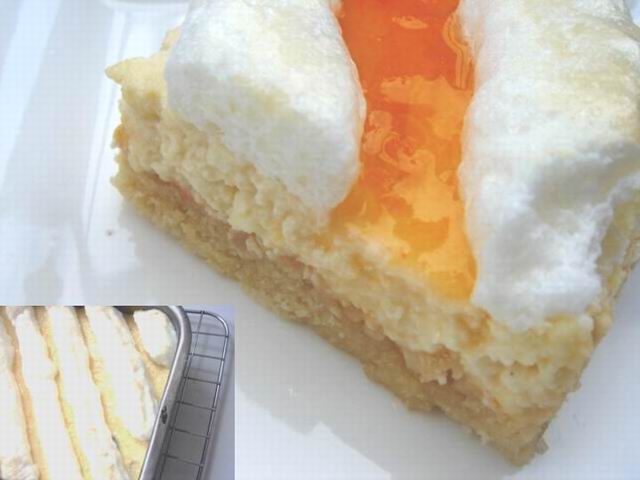
Finally I decided for this sophisticated cake: „Curd cheese square Rákóczi style”, because 1. I’ve never prepared it from scratch, 2. it has even something to do with Belgium where I live right now.
The cake was namely named after János Rákóczi, a Hungarian chef (1897-1966) According to some sources the cake was popular in the thirties and the recipe was first published in 1937 for a food magazine „Magyar Szakács” (The Hungarian Cook). However, it aquired some international attention at the EXPO 58 – the Universal Exibition in Brussels in 1958 where it was served at the Hungarian restaurant. (According to other sources, the cake itself was in fact invented for the menu of the restaurant).

You can get this cake at every pastry shop in Hungary, there might be slight differences in the look – the original version has some meringue grids on its top, filled in between with apricot jam, other versions have a very thick layer of meringue. The base is a thin paté sucré crust, followed by a layer of sweet curd cheese filling and finally that meringue. As for that curd cheese you might try to drain ricotta or fine curd cottage cheese overnight through a paper-towel lined sieve set over a bowl, I think that would probably give you a good substitute. Dry curd cheese is preferred for the filling because a wet, creamy one would melt, giving a soft, runny texture.
Recipe

Ingredients (for 12 pcs)

Dough:
150g flour
75g cold butter
40g icing sugar
1 tbsp sour cream
pinch of salt

Filling:
500g curd cheese
100g sugar
3 egg yolks
grated zest of 1 lemon
100ml sour cream
big handful of raisins

For the meringue:
3 egg whites
50g icing sugar
optional: apricot jam

Preheat oven to 200C. Mix flour, butter, sugar, salt and sour cream. Let the dough rest for 15 minutes in the fridge. In the meantime prepare the filling: mix the curd cheese, sugar, yolks, lemon zest, sour cream and raisins. (Some recipes advise to put the curd cheese through a sieve, I didn”t because I prefer the more crumbly texture). Roll the dough to the size of a baking pan (18x25cm) and bake it for about 15 minutes or until lightly golden. Reduce the oven temperature to 180C. Spread the cheese mixture over the base and bake until set (about 20 minutes). Reduce the oven again to 160C. Whisk the eggwhites untill stiff (add sugar at the end). Now you have two options: either you simply spread all the meringue on the top of the filling, or (like I did) you pipe some strips (or grids) of it on the top. Bake for 5-10 minutes until just lightly dried. Let completely cool and cut into squares. If you made the srips or grids, fill in between with apricot jam.


Címkék:


péntek, január 27, 2006

Apple-Pear Meringue Layer Cake without the layer and the cake – SHF#15.

When I occasionally blog in English, most of the time I’m trying to introduce a typical Hungarian dish and recipe. Well, sometimes I manage, sometimes I don’t. It’s definetely easy when it’s Sugar High Friday, as we have so many famous fabulous and absolutely delicious Hungarian pastries and cakes that I have enough recipes to introduce for the next few years. But, huh, Sugar Low…this is really a difficult one! Hungarian sweets with low sugar content…to be honest, not a single one comes into my mind…So I had to play around a bit with different ideas and this was indeed a lot of fun. I came up with something what I really enjoyed preparing and looking at and eating of course. So, Sam, I’m so happy, you decided to choose Sugar Low as the theme for this months SHF, thank you!!! I think it’s such a perfect choice for January when everyone is into dieting and trying to neutralize those christmas cookies.

What I prepared is this Apple and Pear Meringue something, a really quick and easy option. We actually have a great Hungarian dessert that was originally in my mind, it’s called "Máglyarakás” –the dish looks like on this picture. It’ basicly a rich bread pudding layered with apples, walnuts, apricot jam and topped with meringue mixed with one part of that jam. It’s delicious! So basicly that particular dessert was my inspiration for this lighter version but I deconstructed it so much and skipped almost all ingredients (like the bread, eggs, apricot jam, sugar) that I don’t dare to call it even a pseudo-Máglyarakás, otherwise my Hungarian readers would kill me.

This is what I did: I poached the apple and pear pieces in some water infused with lemon, cinnamon and cloves. I took them out of the liquid (I kept the liquid, it tasted great when I soaked a tea bag in it), mixed the fruit with some good quality Hungarian honey (did you know that Hunarian honey is one of the best in the world?) and ground cinnamon, put in an individual ring mould. While the fruit was cooking I whipped up the egg white – I sweetened this with some fruit sugar (fructose). I topped the fruit basis with the meringue and put it in a 160C (325) oven for about 10 minutes ( alittle less in fact).

I absolutely love how this dessert looks, I mean it almost looks like a real fancy cake with a huge dollop of whipped cream, doesn’t it? OK, I admit it would probably taste thousend times better if the apples were cooked with sugar and butter – because the lack of these results that you don’t get that caramelized sticky effect – but you still have a great taste through the spices and the meringue. I think it’s a nice one for winter afternoons and I would anytime serve it for guests.

Recipe (1 serving)

1 apple, peeled and cored, cut in bite size cubes
1 pear, peeled and cored, cut in bite size cubes
1 cinnamon stick
5 cloves
juice and peel of a ½ lemon
2 tbsp good quality honey
1/2 tsp ground cinnamon
1 egg white
2 tbsp fructose

Preheat oven to 160C /325F

Put about 150ml water in a saucepan, bring to boil. Add the spices, the juice and peel of half a lemon. Let simmer. Peel and core the fruits, cut them into bite size pieces. Put in the spicy liquid and cook for about 5 minutes until softened but not overcooked. In the meantime whisk the egg white until stiff , in the last phase add the fructose. Mix the fruit with honey and ground cinnamon and put in a small cake ring (individual size or a big one if you make a big batch). Top with the meringue and place in the oven for about 10 minutes until the meringue gets a nice dark golden colour. Serve immediately. (With some low sugar vanilla ice cream maybe:)


Címkék:


vasárnap, január 15, 2006

My authentic Hungarian Goulash recipe

Bocsánat, ez most nincs magyarul, mert lusta vagyok…de csak sima pörkölt recept a külföldieknek.

Well, originaly, I thought, the only recipe I wouldn’t post about on this site would be the one of a Hungarian goulash. However, then I looked around a bit on internet (before, of course I was never looking for a goulash recipe, since it’s something I’ve cooked thousend times..), have discovered a lot of different recipes with the title of an „authentic Hungarian goulash recipe” and seeing those, I told myself, oh yes, post it! And my parcel sent in the framework of the EBPP (help, where is it, it should have arrived already and no signs yet….) also contains a few ingredients and maybe my adressee is willing to try it. So without any further much ado and without going into poetry about the history of the Hungarian cuisine – which I shall do another time but I’m so lazy for right now.. (but here I found a good article if you are interested –although the author seem to have a Polish name, but still..), here we go:

Let’s start with some quick terminology: there might be some confusion about what exactly is called a goulash (although I think maybe only English speaking Hungarians may have created this confusion because for everyone else it seems to be obvious that it’s that thick meat stew.) But in theory it could cover the following Hungarian dishes:

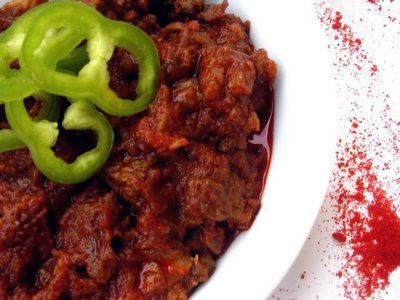
PÖRKÖLT – a slowly cooked thick meat stew (it looks like on the picture above) which can be made of all kinds of meat: beef, chicken, pork or even fish. I consider this one as the typical Hungarian stew that is translated as a goulash in other languages. My recipe goes for this. It’s served normally with bite size dumplings (galuska), or boiled potatoes (or even sometimes with plain pasta in school or company cantines )

GULYÁSLEVES – goulash soup- you see, this one at least really contains the word goulash. This is indeed a liquid soup – the preparation starts exactly the same way as of a stew but then more water is added, plus vegetables (a few carrots, parnsnips and a lot of cubed potatoes). In terms of spices, it contains caraway seeds. So, it has really a soup consistancy and is eaten with some good fresh bread. This one is made of beef only.

PAPRIKÁS – this one is mainly known as the famous chicken paprikash. It is mostly made of -well, chicken, but it’s also common to prepare it with veal or also fish (such as freshwater catfish). The base is absolutely the same as with pörkölt but then a bit more water is added and at the very end of the cooking the sauce is thickened with the addition of sour cream and flour. So it has more sauce on it as pörkölt. This one is always served with dumplings.

(Ok, and finally we also have something which is really called GULYÁS – as it is-it would be a dish somewhere between a pörkölt and a gulyás soup – it would be thicker then a soup and contain potatoes. This would be mainly cooked outdoor in a big cast-iron kettle (bogrács) and most of the time a good amount of red wine would also be added. This is often prepared during folkloristic events for tourists, sometimes at outdoor parties but very rarely in home-cooking.

And by the way, all above (well, at least the three first ones) are dishes which are cooked and eaten in everyday life in Hungary, so those are not touristy dishes offered only on restaurant menus for foreigners but something which families prepare and eat very often.

Now, to the recipe. Of course, you can imagine, there are as many different goulash recipes as cooks. So, this is how we prepare it in my family and I would consider is as a basic recipe for a pörkölt. I think it’s really easy to cook it and you just absolutely can’t go wrong if you follow a few basic rules.

There a two SECRETS of a good goulash: the ingredients you add to it and the ones you don’t. In my opinion the secret ingredient of a perfect Hungarian stew (besides a good quality Hungarian paprika of course) is onion. A lot. More. A lot more!! For 1 kg meat (two pounds) I would use about 3-4 big onions. That seem to be a lot but this will create your thick sauce. As you’re simmering the stew on very low heat for about 1,5 hours, the onions melt into a sweet, spicy sauce, so you won’t have any pieces of it at the end.
What you never ever would add to a pörkölt are any of the following ones: flour, butter, canned tomatoes (all three I see in many „authentic” recipes). There are a few optional ingredients that could be added, this really depends on your taste, on habits and on what you have on hand. (e.g. pork fat instead of oil, smoked bacon, green pepper, fresh tomato, red wine, caraway seeds)

Recipe (4 servings):

1 kg beef for stews, cubed
3-4 big onions, finely chopped
4-5 tbsp groundnut oil
3-4 tbsp best quality Hungarian sweet paprika
salt, pepper
1 green pepper, sliced (the kind which is on the picture, not bell peppers)
1 fresh tomato (this one I add only if I’m in Hungary or if I can get some really tasty good quality tomato, otherwise it just makes the sauce too watery and sour and doesn’t add anything to the flavour)

Heat oil in a saucepan. Add the finely chopped onions and cook until translucent. Now comes an important secret step: remove the saucepan from the heat and now add the paprika – this is very important as if you would do this step still on the heat, the paprika could burn from the sudden heat and get bitter. Put it back, add beef cubes and stir so that the spicy onion mix covers th meat evenly. Cover with about 100-150ml water so that the liquid doesn’t completely cover the meat. Add the sliced green pepper, the whole tomato (later will be removed at the end), salt, pepper. Simmer covered on very low heat for about 1-1,5 hours. After 1 hour, check, add a litle more water if necessary, so the stew doesn’t burn. Depending on the thickness of the sauce, cook for 10-15 minutes uncovered so that all the liquid reduces and all what you get is a spicy, thick sauce which covers the meat. It tastes even better reheated, I normally prepare it a day ahead.

Címkék:


csütörtök, január 12, 2006

The Postman always rings twice – EuroBlogging by Post #3


I swear this is almost even better then Christmas! For the very first time I registered for participating in the third round of EuroBlogging by Post (first organized by Andrew )well before the holidays and was extremely excited about the whole event. Imagine, you get an address of another foodblogger of whatever nationality in whichever country in Europe to whom you are sending a nice parcel of foodie gifts and for that you can expect to recieve another package from someone in Europe – the sender and the country of origin of course remains a secret and surprise until the very last moment. This time the event was organized by Johanna, the Passionate Cook who made a fantastic job with all that organizing and tracking, thank you so much!

But the real big Thank You goes to Johanna, because to my greatest surprise she is the sender of the parcel which I received today early morningl!! Wow, how great is that!! Johanna is Austrian and she lives in London and writes one of my favorite foodblogs, the Passionate Cook. ( By the way just at the end of my last entry yesterday I recommended her recent fantastic sounding choco-mocca liquer and even translated the recipe into Hungarian). She has amazing recipes on her site and makes the most mouthwatering party bites I’ve ever seen.

A couple of days ago Johanna in her capacity as the organizer of the event, sent me an e-mail saying that my parcel would arrive later this week due to some late applications:) I told her, no problem, I’m waiting patiently for mine (but secretly, to be honest, I just couldn’ wait to discover who would be my Santa Claus.). So today very early in the morning (thank you Belgian Post!) at 7.30 am the doorbell rings, I open the door (still kind of underdressed so to say) and there it is: my parcel arriving directly from London and the sender is….Johanna!! Hurraah!! The package is amazing, I LOVE every single item of it. Here is what it includes:

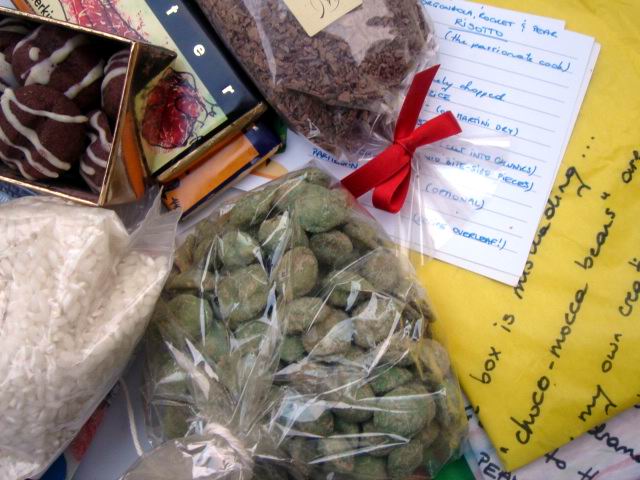
> A bag of a very good quality sardinian risotto rice + a recipe for a gorgonzola-ruccola-pear-risotto as an ultimate comfort food –I couldn’ agree more and already made it (see the picture above)! Johanna has some other great risotto recipes on her site, I think I’m going to try those too.

> A nice chunk of gorgonzola cheese

> A bag of chocolate flakes from Johanna’s local chocolatier Wiliam Curley to make some..hmm..chili vanilla hot chocolate maybe?
> A box of her homemade chocco-mocca beans – recipe here – and I’m telling you, these sweet cookies look so cute innocent, but boy taste they amazing! These are cookies for adults, very rich, very chocolatey, I totally fall in love with them

> Two very special chocolate bars from an Austrian chocolate company Zotter who produces the weirdest flavour combinations according to notes of Johanna. One is filled with strawberry-cream (and called Ein kleiner Trost –„a little consolation”) and the other with sour-cherry-marzipan and sesame nougat. I checked their website and they really offer a wide choice of interesting flavours from pinneaple+paprika to black beer+wild rice (Do I read it correctly Johanna that your favorite is the one with pork scratchings??:))
> A bag of wasabi peanuts – Johanna writes that she is addicted to them – oh, now I can understand why. I can remember reading about those in Angelika’s post when she visited Johanna. They are crunchy, spicy, salty, hmmm. Actually, it’s a kind of hard mental training to be able to stop eating them. In the morning I returned into my kitchen after every step of my make-up to nibble on them (which resulted in two things: 1. I was absolutely late at work, 2. I ate almost half of the bag for breakfast (now, am I a gourmet, or what:)?)

> And finally a bag of dried hot chili linguine made of pure durum wheat semolina + a recipe for a chili linguine with crab, lemon& rocket sauce.

I’m absolutely thrilled and happy with all these fantastic goodies, and can’t wait to use them at some special occasions. Johanna, THANK YOU VERY MUCH, Tausend Dank!!!!!!

And I just finished the bowl of this risotto, which is – and believe me, I’m not exaggerating – one of the best dishes I’ve ever eaten in my life, I can only urge you to try it!! This classic combination of pear, gorgonzola and rocket is fantastic in the risotto –it’s such a sophisticated dish! Creamy, full of exploding flavors, the ultimate comfort food for a winter evening. I followed the instruction of Johanna word for word, the end result is perfect. Johanna, I hope you don’t mind if I post the recipe – I also translated it into Hungarian for that language version of this post!

Johanna’s Gorgonzola, rocket &pear risotto (for 2)

2 shallots, finely chopped
200 risotto rice
125ml Noilly Prat (or Martini dry)
375ml chicken stock
150g gorgonzola (cut into chunks)
1 medium pear (cut into bite-size pieces)
50g rocket salad
parmesan to serve (optional)
­­*I sprinkled the top with a handful of chopped walnuts

Fry shallots in 3 tsp olive oil until just starting to brown. Add rice and fry for another 2 min. Deglaze with Noilly Prat. When evaporated /absorbed, top with ¼ of the stock. Turn heat to low setting. Cook until absorbed. Add another ¼ of stock, let absorb. Add the cheese, let it melt, then add another ¼ of stock. Leave to absorb and infuse, stirring constantly. Add the pear and the remaining stock, cook until liquid is almost completely gone and rice is cooked al dente. Fold in the rocket until wilts.
I hope that the parcel sent by myself will make at least the same great pleasure as this one. (No signs yet from x). Oh, and tomorrow I'm going to post that Hungarian goulash recipe in English.

Címkék:


vasárnap, november 27, 2005

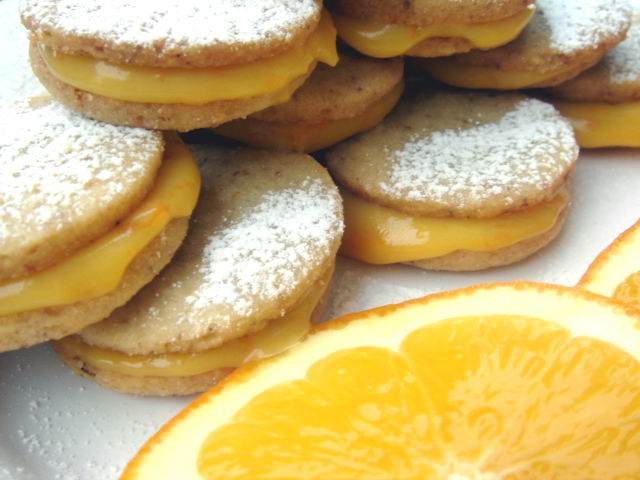
Cinnamon and Walnut Linzer Cookies with Orange Curd -IMBB/SHF Cookie swap

To be very honest I’m not that much a cookie person. I do love sweets (well, that’s maybe an understatement indeed….) and I also love to prepare desserts. But I prefer to make cakes or ice cream or puddings. I very rarely bake cookies. Because you need to be patient and very precise for that. And because you have a lot of them in the house then and you eat all of them....So, baking in general: yes, but normally I try to avoid anything wich requires rolling and dusting and cutting. But I soo wanted to participate in this fantasctic joint IMBB/SHF event, organized by the inventors of these events, Alberto and Jennifer that I decided to give it a try. And anyway, I blog in Hungarian but I love to participate in these events and do only these posts in English. And at these occasions I enjoy so much to open the doors a little and step out to the international world of foodblogging. And these cookies turned out so perfect that I might get into that cookie baking mood..
Actually I wanted to make something Hungarian but I realized that the really typical sweets and our most famous pastries are all big cakes or rich, filled pastries. No cute, little cookies.
So, I decided to make something which I have been making for a couple of times for Christmas and it was always a big hit: mini Ischler cookies, those famous elegant Austrian cookies made of two linzer cookies sandwiched together with raspberry jam and glazed with chocolate. And with that I’m only some hundreds kilometers far from the Hungarian border..
But then what happens: I realize, no chocolate, no raspberry jam in the house. And since we got such a huge snow over the night here in Brussels that I just really enjoyed so much being home and was absolutely lazy to go to anywere, so I applied the creative approach and filled those cookies with something else: orange curd. ( So, actually I should call these cookies Ischler with orange curd but that sounds a kind of bizarre, don’t you think?) I totally love lemon or other citrus curd (which is by the way absolutely unknown in Hungary – for the Hungarian version of this post I really had to think for an appropriate translation). I tried a few different recipes and I found one which is the perfect one for my taste: it is included in a fantastic book, one of my favorites: Serena, Food &Stories. So I used this recipe, substituting oranges for lemons.
All in all, I love these cookies. I absolutely don’t recomment to make them ahead (although they probably keep very well) because you will need to make new batches again and again every weekend until Christmas…

Recipe (makes 30 pieces):

Cookies:
200g/7oz all purpose flour
150g/5oz cold butter
100g/3,5oz icing sugar
70g/2,5oz ground walnuts
pinch of salt
big pinch of cinnamon

Orange curd:
(For the cookies you will need only half of this recipe, but I always make the whole batch and freeze the other half)
100g/½ cup sugar
zest of two big oranges
½ cup fresh orange juice (1 big orange)
1tbsp fresh lemon juice
4 egg yolks
2 whole eggs
120g/8 tablespoons of butter

Prepare the orange curd (at least a day ahead): put orange juice, zest, sugar, salt in a saucepan and whisk. Add egg yolks and whole eggs and whisk smooth. Cook, stirring constantly over medium heat until it starts to bubble. Now add the butter and stir until the mixture thickens. Cool and store in the fridge. (Keeps for a week int he fridge or int he freezer for two months.)
Prepare the cookies:
Preaheat oven to 180C/350F.
Make a firm dough mixing the flour, sugar, ground walnuts, cinnamon, salt and the butter (I like to grate the cold butter). I make it with my hand but you could certainly use a food processor for this. Form the dough into a ball, wrap in plastic foil and refrigerate for 30 minutes. Roll out the dough (I find it easier to do this in two batches) and cut small circles with a cookie cutter (inch). Put the cookies on a baking sheet covered with parchment paper (or a silicon sheet) and bake for about 6-7 minutes. They shoul be light in color and feel still a little underdone (the will set as they cool). Cool completely.
Assemble cookies:
Sandwich each two cookies with a little orange curd. (Resist to put too much curd between otherwise you lose control over the shape and the filling will ooze on the sides)
And now comes the toughest part of the recipe: let rest for at least half a day covered with foil so that the cookies can soften.

Other Posts in English

Added on 10th December:
I just realized that I've been voted with this among the best 12 cookie recipes of the Cookie swap organized jointly by Jennifer and Alberto. I'm totally surprised and very honoured! I can't wait to receive that funny Cookie Sutra book... So THANK YOU everyone for visiting and for voting, you made my day! And congratulations to all other participants because I think all those 152 cookies are just amazing!

Címkék: ,


vasárnap, október 23, 2005

Spiced Quince Soufflé - IMBB 20.

OK, there is no doubt anymore, I confess: I’m seriously quince obsessed. Two weeks ago, I bought the first bag of them at the Brussels market – the first arrivals this year I was told. So I came home and made that quince paste (or quince cheese as we call it in Hungary –a couple of years ago one could still buy this at the market in Budapest from older women from the countryside who made it at home and sold in cute little forms. Today it’s so rare probably because it is so labor intensive). I’ve never had the Spanish membrillo but I think this is probably its equivalent. And I have a very good recipe for this quince paste given to me by the mother of one of my best friends – it’s prepared in the microwave so you spare a lot of time and work. (Basically, the fruit is cooked unpeeled and uncored then in the micro then pureed, strained and cooked again with the same amount of sugar as fruit then put in forms for a couple of days. It keeps for months, although I don’t have that kind of own experience, you understand…).

Then I tried this chicken with quince dish which turned out to be absolutely amazing.

I still had some so I made a Vanilla Quince and Pear Jam.

Then I went to the market and I just had to by some more (they are very cheap here, only 1.50 Euro/kg…)

Then I’ve read this wonderful post of David Lebovitz about quinces (seems that we are many quince lovers out there..) and got even more excited….then also Angelika at The Flying Apple wrote about them, she received some through her Euro Blogging by Post package.

So when considering what to make for this month IMBB, the event originally invented by Alberto at Il Forno, this time hosted by Kitchen Chick , I had something in my mind. The scary scary theme of this months event is SOUFFLÉ. The only soufflé I’m making regularly is an easy chocolate soufflé but I haven’t tried any others yet. I think, a soufflé is a dish for entertaining but I really prefer to have the dishes prepared in advance and my guests are anyway always late…
But I was flirting with this recipe since ever and it seemed to be perfect for this time. The book is called The World Encyclopedia of Fruit (I have the Hungarian version) – a great reference book with good recipes. So I made this quince soufflé and I succeeded! Huh, I wasn’t really quite sure this time…I modified the recipe slightly and spiced it up a little with some cinnamon and ginger to give some extra fragrance. I prepared only the half of the original recipe and got 4 soufflés. It is very delicious, I could have eaten the whole batter as it was before baking it..

By the way, taking that picture was the most difficult part of the whole project, I cant’ wait to see how all of you managed. With me it meant some serious finger burning, broken pieces of the jar containing icing sugar, that icing sugar on he kitchen floor and, oh yes, great panicking that the soufflé would fall in two seconds before any chance to take a picture…

Oh, and I still have 3 big beautiful quinces in my kitchen….

Recipe:

Ingredients (4 servings)

1 big quince
100ml water
50g caster sugar
juice of ½ lemon

125ml/ ½ cup milk
1 vanilla pod
½ teaspoon ground cinnamon
½ teaspoon ground ginger
2 egg yolks
3 egg whites
2 tbspoon flour
2 tbspoon sugar
1 tbspoon eau de vie de coings (quince liquor) you can substitute with pear schnaps or kirsch)

butter and sugar for the ramekins

Preheat oven to 200C/ 400F
Prepare the fruit puree: peel and core the quince (good quality and sharp peeler and knife will be very helpful, because the fruit is very hard), cut in small cubes and put in the water with lemon juice and sugar. Cook until soft (ca. 15-20 minutes). Let cool a bit and puree in a food processor with 1-2 tspoons of the liquid. Strain through a sieve (I didn’t so the soufflé was a bit chunky which I liked)
Now prepare the batter: heat the milk with the vanilla and the spices. Mix the egg yolks with the sugar until pale, add flour. Pour over the hot milk and put back ont he stove and cook a few minutes until thickened (a little thicker then a custard)
Mix the quince puree into batter.
Beat the egg whites until it forms soft peaks. Gently fold into the fruity batter mixture.
Butter four ramekins and sprinkle with icing sugar. Pour the batter in the dishes and run a sharp knife around which helps to rise.
Bake for 8-10 minutes until risen.
Serve very immediately.

And here you can find over 50 fantastic sweet and savory soufflé creations of the other foodbloggers.

Címkék:


péntek, október 21, 2005

RIGÓ JANCSI – Classic Hungarian Chocolate Sponge Cake with Rich Chocolate Mousse Filling and a great romantic story – SHF 13.

Hurrah, it’s Sugar High Friday again, the monthly international sweet Friday event that is a perfect excuse to make some guilty, divine desserts. This event was originally an idea of Jennifer at Domestic Goddess who is a foodblogger from Canada and this is the 13th time it has been announced. This time the event is hosted by Kelli in New York at Lovescool and she has proposed the decadent theme DARK CHOCOLATE.
In Hungary we have such a wide choice of great pastries and cakes, but strangely enough, chocolate is not among the most used ingredients. Those are more walnuts, poppyseed, curd cheese and seasonal fruits. But then this cake came into my mind which I haven’t had since ages. It is a kind of old fashioned but you can still get it in every pastry shop in Hungary. And besides its VERY HEDONISTIC characteristics (think of a rich chocolate mousse between two layers of chocolate sponge covered with dark chocolate glaze) it has such a great Belgian-Hungarian fusion romantic story that this was the final argument to make it for this event. And here it goes:
The cake is named after Rigó Jancsi, a famous Hungarian gypsy violinist in the early 20th century. He was playing with his orchestra all around Europe and once he was playing in a restaurant in Vienna (or according to some sources it was Paris in fact), the Belgian duke of Chimay was dining there with his young beautiful wife, a daughter of an American millionaire. She was totally fascinated by his music but even more so by his passionate black eyes. They immediately fall in love, the duchess left the husband and they lived together in different countries. Of course this was a huge scandal and a hot story at that time. I even found a Hungarian book from 1981 in which the old cousin of Rigo Jancsi tells the true story as he remembers, it is so funny, I put the link for the Hungarian speaking readers here, you just have to read it!
The cake itself is quite labor intensive to tell you the truth but that doesn’t mean we wouldn’t make it does it? And I live in Brussels at the moment which means that I’m very spoiled with access to some really good quality chocolate. So this time I used a dark chocolate with 85% cocoa (very bitter but very rich and fine). Surprisingly it was not at all so easy to find a proper recipe, probably because this cake is so old fashioned. So, I finally followed this recipe which I found on the website of the famous Gundel restaurant in Budapest, owned by George Lang, a famous restaurateur and food consultant of Hungarian origin, also owner of the Cafe Des Artistes in New York. I halved the recipe for the filling because it says it makes 16 slices (well, the Hungarian version says 16 slices, while the English one says it makes 4 servings, I think they just made a mistake I guess.) With the half amount of the filling I got 6 servings. (For the sponge however I made the whole amount and used the other half for something else)

Recipe:

Ingredients (for 6 servings)
For the Sponge Cake (*you will need only the half of the sponge if you go for 6 servings)
3 large eggs, separated
60g/ ½ cup granulated sugar
60g/ ½ cup all-purpose flour
20g/ 2 tablespoons unsweetened cocoa powder
Filling:
100g/3 ounces chocolate, coarsely chopped (*I used dark chocolate)
400ml /1 pints whipping cream, whipped to firm peaks
* I added about 50g /ca.1/2 cup sugar because of the bitterness of the chocolate I used
Glaze
50g/ 1,5 ounces chocolate, coarsely chopped
half tablespoon vegetable oil

Sponge Cake
1. In a big bowl, combine the egg yolks and the sugar. Whisk until foamy and set aside. Beat the egg whites to stiff peaks. Fold the whites into the yolk foam. Whisk the flour and cocoa together and then gently fold the dry ingredients into the batter.2. Line a baking sheet with waxed paper (*I used a silicon matte, perfect for this). Spread the batter over the wax paper (pr silicon matte), using a kitchen knife to spread it into a thin layer.. Bake in a preheated 180C/350 ºF oven for exactly 8 minutes until the cake springs back when lightly pressed in the center. Let cool for about 5 minutes.
Filling
1. In the top of a double boiler or a metal bowl set over simmering water, melt the chocolate, stirring until smooth. Remove from the heat and stir in a third of the whipped cream. When incorporated, add the remaining whipped cream and stir gently and carefully. Do not overmix.2. Using a long serrated knife, cut the cake into two halves. (The one half I used for another recipe) Cut the one half in two pieces again. Transfer 1 layer to a flat platter and spread the chocolate mousse over it. Refrigerate until firm (I let it overnight). Don’t even think of adding gelatin, the mousse will really firm in the fridge.
Glaze
In the top of a double boiler or a metal bowl set over simmering water, combine the chocolate and oil and heat, stirring constantly, until the chocolate melts and is smooth. Pour the glaze over the second cake layer, spreading it with a dry knife to cover the cake evenly. When the glaze firms up, cut it into 6 squares, remove the chilled layer from the refrigerator and carefully set the glazed layer on top of it.
Cut the cake into 5x5cm/2-inch squares, using a thin-bladed knife dipped in warm water and wiped dry between each cut.
And here you have the summary of all 75 dark chocolate recipes prepared for this event.

Magyarul

Other posts in English:

Címkék: ,


szombat, október 08, 2005

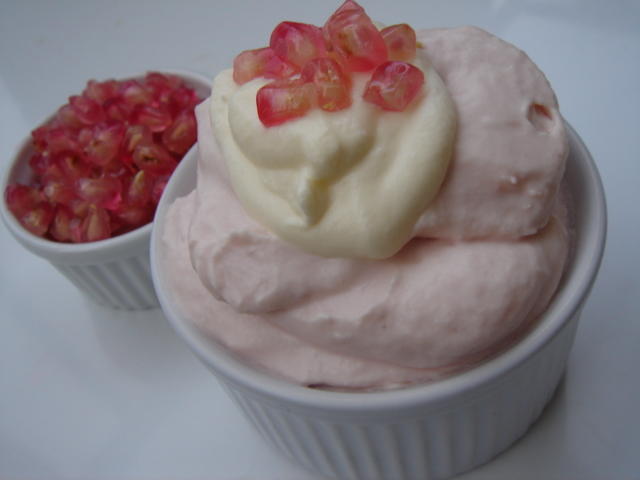
In The Pink - Pomegranate Mascarpone Ice Cream


I blog in Hungarian but I decided to participate in some of the international food blogging events and do those posts in English in order to be able to interact sometimes with the international food blogosphere. So far I participated only ones but was that fun! I discovered this event through the fantastic site of the most talented Keiko and new immediately that I'm participating. The idea comes from Emily over at La Dolce Vita, she introduced the event called In The Pink. The purpose is obviously breast cancer awareness raising (October is worldwide the month of this). The task was to make something pink (food of course, what else..) and blog about it.
And you know, I don't think I take myself too seriously with this whole blogging thing (well, or do I?) but it was so clear that I want to participate. Because it's a good cause and because it's such a big fun to play around with colors in cooking, isn't it? And if we raise awareness only among ourselves it was worth already. Thank you Emily for hosting this event.

And with pink there are endless possibilities, the hardest thing was to decide which option to go for. I was thinking of a rasperry ilé flotante or maybe a beetroot-goat cheese mousse but then decided something else. I had some beautiful pomegranates left from another dish I made a couple of days ago and I was so ecstatic about their fantastic pink color and extravagant look that I wanted to try something with those. I got some inspiration from a recipe called Pomegranate Parfait (by the way, there are some great recipes on that site) but didn't finally used that particular recipe (they use gelatine and egg yolks and I wasn' sure I would get the result I'm looking for) but tried it rather my way.

First I prepared a syrup with sugar and the pomegranate juice but also added some cinnamon and cardamom pods to give it an interesting fragrance. This worked beautifully, great taste, fantastic pink color. Then I mixed the mascarpone and whipped cream together and added the pink syrup. Well, this is where my nice strong pink color got suddenly lost, don't ask me to where, I have no idea...I was expecting to get a pale pink mousse, instead I had a kind of beige one. Tastes still great -sweet and a little sour and aromatic and you can't immediately name all ingredients. But since in this case the color was really important I had two choices: either I add some natural coloring, like rasberry syrup but then the original taste is gone or I keep the taste and add a few drops of food coloring which I normally never use. I opted for the latest. All in all, I was very happy with the outcome, although I will work a little bit more on the recipe and try maybe yoghurt instead of the mascarpone which I found a little to heavy for ice cream.

Recipe:

Ingredients (for 500ml ice cream)

1,5 dl pomegranate juice ( I used one and a half fruit)
100g caster sugar
1 cinnamon stick
4 cardamom pods, bruised
200g mascarpone at room temperature
1,5dl double cream, whipped
pomegranate seeds for decoration

First, press the juice of the pomegranates. You can use a citrus press machine which makes life quite easy. Pour the juice with the sugar in a small pan, add the spices, bring to boil and cook for a few minutes. Chill( I put it in a bowl with icecubes in order to be able to work with it that day but you could preapare the syrup the day before). Whisk the mascarpone until smooth and carefully fold in the whipped cream. Now, add the syrup (take out the spices) and mix well. If you want, add a few drops (I used 3) of red food coloring. Churn in the ice cream maker according to manufacturers instructions (it took mine 15 minutes). Serve sprinkled with beautiful pink crystal pomegranate seeds.
Take care all of you!

Címkék: ,


péntek, szeptember 16, 2005

Hungarian poppyseed bread&butter pudding with an orange vanilla custard (Mákos guba) - SHF 12.

You see, I made the decision to write my blog in Hungarian (by the way, I’m not aware of any other Hungarian food bloggers, are you?). But to be honest, I just absolutely couldn’t wait to participate in one of the international food blog events, so I decided to do a few entries in English. This allows me to become a guest of the international blogosphere at least from time to time. This is my very first participation in a Sugar High Friday, idea of Jennifer at Domestic Goddes, so I thought I would come up with a nice Hungarian sweet, this is anyway the best part of our cuisine. And when I saw at Elise’s site who is kind to host the event this time, that theme would be custard , after a short consideration I knew what I want to prepare.

This easy dish is a kind of comfort food that families would prepare on weekdays and eat it maybe after a hearty soup. Of course then it’s not served in a fancy way like I did – no individual servings, no sauce, etc. (not speaking of the little siruppy kumquats I put on the top- indeed, not very Hungarian:)) – basicly, the recipe then would be just: pour some sweet hot milk over bread, sprinkle with poppyseed and sugar and eat…well, this time I made it a little more sophisticated and richer through adding this and that. In fact, this pudding is sooo delicious that some people have it as a christmas eve dessert. You know, just before Hungary became a member of the European Union in 2004, some eurosceptic groups would announce in their anti-EU communication campaign that because of EU legislation it will be forbidden to sell and buy poppyseed in Hungary and we will be never ever anymore allowed to eat our favourite yummy dishes with poppyseed, like Makos Guba (yes, this is the name of this dish). Of course it turned out not to be true and a whole nation was relieved. (It is true however that in some countries there are some strict rules on poppyseed production due to its high opium content). In most of the countries it can be hard to get ground poppyseed - you can buy either whole poppyseed in small bags or processed, sweetened and flavoured cake filling poppyseed. If you use the whole ones, you need to grind it in a spice or coffee grinder before using. (So, this is also one of the small secret bags that travel with me regularly on the Budapest-Brussels flight.) But it is worth believe me! I need to prepare this for my friends from abroad really many times. Always a big hit. Ah, one little warning: Don’t forget to brush your teeth immediately after eating it, in order to avoid funny comments about cute little insects, you know what I mean..

Recipe:

Ingredients (4 servings):

80g ground poppyseed
100g icing sugar
600ml milk
2 egg yolks
4 tbsp caster sugar
one piece of an orange peel
seeds of ½ of a vanilla bean
12 slices of some sweet bread, or rolls (e.g. milk loaf or challach)
50g unsalted butter
2 tbsp honey

For the orange vanilla custard sauce:
200ml milk
200 ml cream
2 eggyolks
seeds of ½ of a vanilla bean
100g caster sugar
one piece of an orange peel
1 tablespooon orange liqueur (I used Cointreau)

Preheat oven to 180C.
Mix the ground poppyseeds with the icing sugar and set aside. Combine caster sugar and egg yolks until pale. Heat up the milk with the vanilla seeds and the orange peel and pour over the egg sugar mixture. Put back on heat and cook until thickened just a litte (it should remain liquid) Slice the bread or roll, butter an ovenproof dish (or individual ramekins) and put one layer bread slices into it. Pour over the hot custard, let soak a little and sprinkle with a layer of of the ground poppyseed and icing sugar mixture. drizzle with some honey and put some flakes of butter on it. Repeat the procedure once again or until all bread is used. The last layer on the top should be bread. Put flakes of butter on the top and put the dish in the oven for 25 minutes.
In the meantime prepare the second custard which will become the sauce. This is the standard way of preparing it, nothing new, just heat the milk and cream with the sugar, vanilla seeds and orange peel, pour over the eggyolks and cook until thick. Add the orange liqueur.

Címkék: